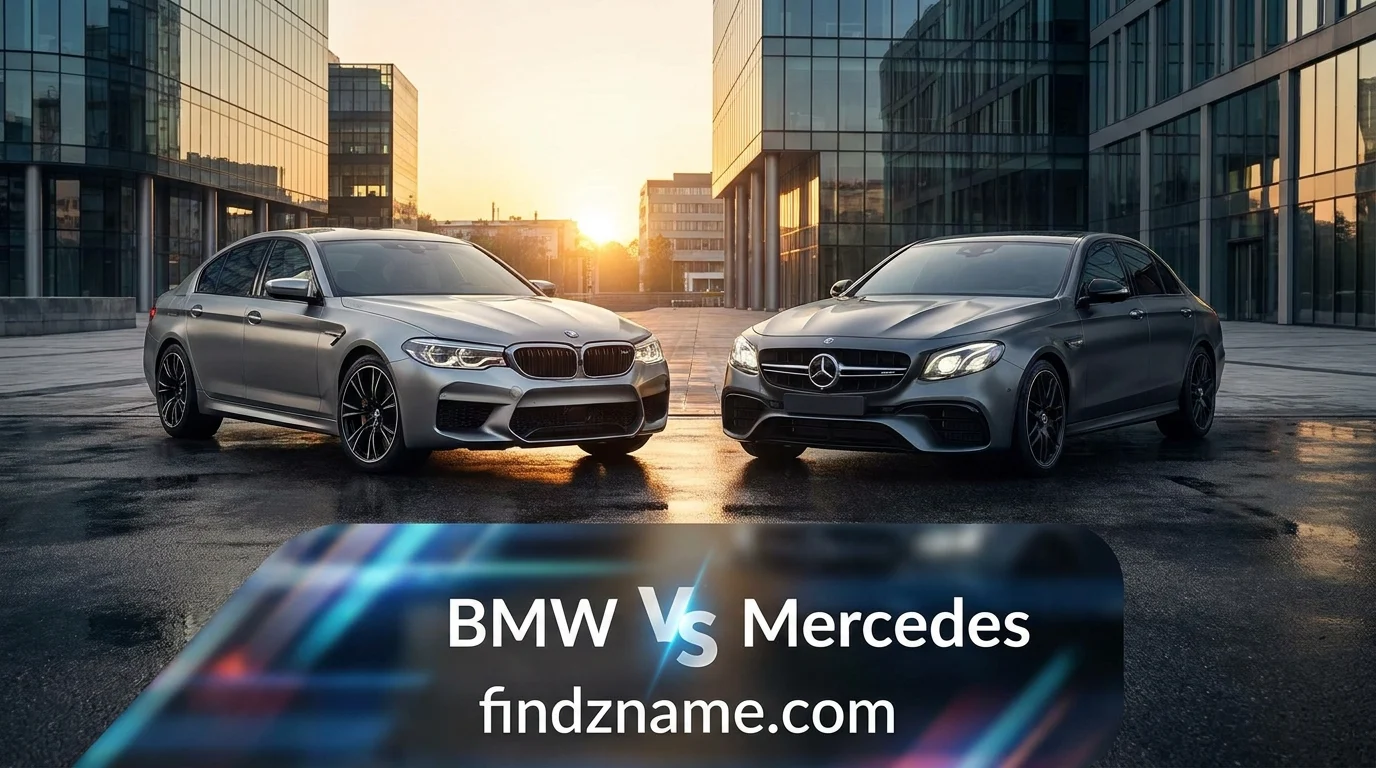
The BMW vs Mercedes comparison comes down to driving performance, interior comfort, technology, reliability, and long-term ownership costs. Both German automakers build premium vehicles, but they approach luxury differently. BMW generally emphasizes engaging handling and sporty performance, while Mercedes-Benz places a strong focus on refinement, cabin atmosphere, and comfort.
However, choosing between these brands is not as simple as declaring one the winner. A BMW 3 Series and a Mercedes-Benz C-Class serve similar buyers, whereas the BMW X5 and Mercedes-Benz GLE compete in the luxury SUV segment. Their prices, features, performance, and running costs also vary by model, engine, equipment, and market.
This guide compares the two brands using available manufacturer information and independent reliability research current to October 2026. It explains their strengths, examines representative models, and helps buyers decide which luxury car better suits their priorities.
Quick Answer: BMW vs Mercedes
BMW is generally the better starting point for drivers who prioritize sporty handling, responsive performance, and an engaging driving experience. Mercedes-Benz is often more appealing to buyers who value a refined ride, an elegant cabin, and a comfort-focused luxury experience.
Neither brand wins every category. Reliability depends on the individual model and model year, while price and ownership costs depend on the country, powertrain, maintenance history, and warranty.
| Category | BMW | Mercedes-Benz |
|---|---|---|
| Driving experience | Sporty and driver-focused | Refined and comfort-oriented |
| Ride comfort | Balanced between comfort and control | Often emphasizes smoothness and refinement |
| Interior design | Modern, functional, and driver-oriented | Often emphasizes luxury and visual drama |
| Performance models | BMW M | Mercedes-AMG |
| SUV selection | X-series SUVs | GLA, GLC, GLE, GLS and other SUV lines |
| Electric vehicles | i-series and electric X models | EQ models and electric versions of other nameplates |
| Reliability | Strong recent independent brand-level results | More variable results across models |
| Best suited to | Drivers who enjoy driving | Buyers who prioritize comfort and luxury |
These are broad brand tendencies rather than universal rules. A particular Mercedes-AMG can be more performance-focused than a standard BMW, just as a well-equipped BMW can be exceptionally comfortable.
1. Brand Heritage and Luxury Philosophy
BMW and Mercedes-Benz have deep roots in German automotive engineering, but their brand identities developed around somewhat different priorities.
BMW is closely associated with the phrase “Sheer Driving Pleasure.” Its vehicles commonly emphasize steering response, chassis balance, acceleration, and the connection between driver and road. The brand’s lineup includes everyday sedans, practical SUVs, electric vehicles, and high-performance M models.
Mercedes-Benz, meanwhile, has long emphasized comfort, engineering refinement, safety development, and premium presentation. Its range stretches from compact luxury cars to executive sedans, large SUVs, and Mercedes-Maybach vehicles designed for the highest levels of luxury.
These differences influence how the cars feel rather than establishing a strict rule about every model.
| Brand characteristic | BMW | Mercedes-Benz |
|---|---|---|
| Traditional identity | Sporty luxury | Refined luxury |
| Driving priorities | Handling and responsiveness | Comfort and composure |
| Interior approach | Driver-oriented technology | Ambient design and premium presentation |
| Performance division | BMW M | Mercedes-AMG |
| Ultra-luxury division | Luxury-focused 7 Series models | Mercedes-Maybach |
| Typical buyer appeal | Enthusiasts and active drivers | Comfort-focused luxury buyers |
Both brands offer powerful engines, advanced driver-assistance features, sophisticated interiors, and premium materials. Therefore, the better choice depends on the specific vehicle and how you intend to use it.
2. BMW vs Mercedes: Performance and Driving Experience
Performance is one of the most important differences buyers consider when comparing these luxury brands. BMW has a strong reputation for balancing engine power with precise handling, while Mercedes-Benz often combines strong acceleration with a smooth and composed driving experience.
Nevertheless, both companies produce vehicles that overlap considerably in performance.
BMW’s 3 Series, for example, is designed to combine everyday usability with responsive driving dynamics. Higher-performance versions, including the M3, add more powerful engineering and track-oriented capabilities.
Mercedes-Benz offers comparable choices through the C-Class and Mercedes-AMG C-Class family. The standard versions emphasize premium everyday driving, while AMG models target buyers who want substantially more performance.
How their driving characteristics compare
| Driving factor | BMW tendency | Mercedes-Benz tendency |
|---|---|---|
| Steering feel | Often more communicative | Often lighter or comfort-oriented, depending on model |
| Cornering | Emphasis on agility and balance | Emphasis on stability and composure |
| Acceleration | Strong across standard and M models | Strong across standard and AMG models |
| Suspension | Sporty calibration on many models | Comfort-focused options across much of the range |
| Highway driving | Stable and engaging | Quiet and relaxed in many models |
| Performance versions | BMW M | Mercedes-AMG |
These are general observations, not measured results for every car. Wheel size, tires, suspension options, engine choice, and driving modes can change the experience considerably.
For a fair comparison, test vehicles with similar power outputs and equipment. A performance BMW should be compared with an appropriate AMG model rather than an entry-level Mercedes-Benz.
3. Interior Quality, Comfort, and Technology
The interior is where the BMW-versus-Mercedes decision becomes particularly personal. Both brands offer high-quality materials, digital displays, smartphone integration, customizable settings, and optional comfort features. However, their design priorities and interface layouts can differ.
BMW generally emphasizes a cockpit-like environment in which the driver can access vehicle information and controls easily. Its curved display arrangements and digital interfaces create a contemporary appearance, although the experience varies by model and model year.
Mercedes-Benz often places greater emphasis on the visual impact of its cabin. Depending on the vehicle and trim, buyers may find ambient lighting, decorative trim, sculpted seats, and expansive screens that contribute to a more lounge-like atmosphere.

BMW interior
A modern, driver-oriented cockpit with digital displays, a clean dashboard layout, and a focus on functionality.

Mercedes-Benz interior
A design-led cabin that can emphasize ambient lighting, elegant trim, digital technology, and a premium atmosphere.
Which brand is more comfortable?
There is no universal winner. Mercedes-Benz may appeal more to drivers who prioritize a relaxed ride and a luxurious cabin, while BMW can suit drivers who want supportive seating and a balance between comfort and sporty control.
However, seat design, ride height, suspension, tire sidewalls, and optional packages matter more than the badge alone.
Before purchasing, check:
- Front-seat support and adjustment range.
- Rear-seat legroom and headroom.
- Ride comfort over rough roads.
- Road and wind noise at highway speeds.
- Ease of using navigation and climate controls.
- Cargo space for your everyday needs.
For family use, the rear seats and luggage area deserve as much attention as the dashboard. A beautifully designed interior is less useful if it does not suit your passengers.
4. Reliability and Maintenance Costs
Reliability is a crucial part of any luxury-car comparison because repairs, replacement parts, and specialist labor can be expensive. Although BMW and Mercedes-Benz both build sophisticated vehicles, their reliability results differ by model and model year.
An important independent reference is Consumer Reports’ 2026 automotive brand ranking, published in December 2025. Its brand-level results placed BMW second overall and fifth for new-car reliability, while Mercedes-Benz ranked 23rd overall and 19th for new-car reliability. These are U.S. survey-based rankings, not guarantees about every vehicle. Consumer Reports explains its methodology and brand results in its 2026 brand rankings.
Consumer Reports
+2
The findings give BMW an advantage in this particular comparison, but buyers should not interpret them as proof that every BMW is more dependable than every Mercedes-Benz.
| Reliability consideration | BMW | Mercedes-Benz |
|---|---|---|
| 2026 brand-level position | 2nd overall; 5th in new-car reliability | 23rd overall; 19th in new-car reliability |
| Repair complexity | Can be high on sophisticated models | Can be high on sophisticated models |
| Parts and labor | Premium-brand costs | Premium-brand costs |
| Used-car condition | Strongly affects reliability | Strongly affects reliability |
| Best buying approach | Research the exact model and year | Research the exact model and year |
Source: Consumer Reports’ 2026 brand assessments. Rankings reflect its U.S. research and may change in future survey editions.
What affects ownership costs?
The total cost of ownership includes more than the purchase price. Insurance, fuel or electricity, scheduled servicing, tires, brakes, taxes, depreciation, and unexpected repairs all matter.
For example, a high-performance BMW M model can cost considerably more to maintain than a regular 3 Series. Similarly, an AMG Mercedes-Benz may require more expensive tires, brakes, or specialist work than a standard C-Class.
To reduce risk when buying used:
- Obtain a complete service history.
- Arrange an independent pre-purchase inspection.
- Check for outstanding recalls and unresolved warning lights.
- Review the vehicle’s warranty and service coverage.
- Obtain insurance and repair estimates before committing.
- Inspect the transmission, suspension, electronics, and cooling system.
Practical verdict: BMW has the stronger position in the cited 2026 brand-level reliability assessment, but the best used-car purchase is the specific vehicle with the better maintenance history, inspection results, and ownership costs.
5. Price and Value for Money
Price comparisons are meaningful only when the vehicles come from the same market and model year. Both brands sell entry-level luxury cars, mid-size sedans, large executive vehicles, performance models, and electric cars. Their prices can vary significantly with optional equipment and powertrain choices.
For a concrete reference, the manufacturers’ U.S. websites list the following starting prices for selected 2026-era models and current lineup entries. These figures are U.S. advertised starting prices, not worldwide prices or guaranteed dealer transaction prices.
| Vehicle | Advertised U.S. starting price |
|---|---|
| BMW X1 | $43,200 |
| BMW X3 | $51,300 |
| BMW 5 Series | $60,500 |
| Mercedes-Benz GLA | $41,500 |
| Mercedes-Benz GLC | $52,400 |
| Mercedes-Benz E-Class | $63,900 |
Sources: BMW’s official model lineup and Mercedes-Benz USA’s vehicle lineup.
BMW USA
+2
These figures should not be treated as a direct price ranking. The X1 and GLA, X3 and GLC, or 5 Series and E-Class are useful starting points for shopping, but equipment, included features, engine configurations, destination charges, and model-year differences need to be checked before comparing final prices.
Which brand offers better value?
BMW may offer better value to someone who prioritizes driving dynamics and a desirable engine or chassis configuration. Mercedes-Benz may justify its price for a buyer who prefers a particular cabin design, seat comfort, or luxury feature package.
However, a lower starting price does not automatically mean lower ownership costs. A more expensive vehicle could include equipment that would otherwise be optional, while depreciation and insurance may change the overall calculation.
Compare the following before making a decision:
- Final negotiated price, including mandatory fees.
- Standard equipment versus paid options.
- Fuel economy or electricity consumption.
- Warranty length and coverage.
- Scheduled maintenance packages.
- Insurance premiums and expected resale value.
For buyers outside the United States, local prices should take priority. Import duties, currency changes, taxes, parts availability, and dealer support can make the same model much more expensive in another country.
6. Sedans Compared: 3 Series vs C-Class and 5 Series vs E-Class
Sedans provide some of the clearest comparisons between BMW and Mercedes-Benz because their model ranges overlap in size and purpose.
Compact executive sedans
The BMW 3 Series and Mercedes-Benz C-Class are popular alternatives for buyers who want a premium daily driver without moving to a larger luxury sedan.
The 3 Series has traditionally attracted drivers who enjoy responsive handling and a more athletic feel. The C-Class offers a refined cabin and a comfort-focused luxury experience, although its driving character depends on the specific engine, suspension, and trim.
| Feature | BMW 3 Series | Mercedes-Benz C-Class |
|---|---|---|
| Main appeal | Sporty everyday driving | Premium comfort and styling |
| Driving character | Often agile and responsive | Often refined and composed |
| Interior | Modern, driver-focused | Design-led and luxurious |
| Best comparison | Equivalent engine and trim | Equivalent engine and trim |
Neither model is automatically better. Buyers should compare the exact versions available in their market, especially when choosing between rear-wheel drive, all-wheel drive, and performance-oriented trims.
Mid-size luxury sedans
The BMW 5 Series and Mercedes-Benz E-Class compete for drivers seeking more space, comfort, and executive-car refinement.
BMW’s 5 Series combines everyday practicality with a strong performance identity. The E-Class emphasizes comfort and technology, making it attractive to buyers who spend considerable time on highways or use their cars for business travel.
A fair comparison should include seat comfort, rear passenger room, ride quality, sound insulation, infotainment usability, and the cost of optional packages.
Sedan verdict: Start with the 3 Series if driving enjoyment is your main priority, and compare the C-Class if its interior and comfort appeal more to you. In the larger class, test the 5 Series and E-Class on the same roads before deciding.
7. SUVs Compared: BMW X1, X3 and X5 vs Mercedes-Benz GLA, GLC and GLE
Luxury SUVs are important to both brands because they combine a premium cabin with a higher seating position and greater versatility.
BMW’s X range includes the compact X1, the mid-size X3, and larger models such as the X5 and X7. Mercedes-Benz offers comparable choices through the GLA, GLC, GLE, and GLS. Each range also includes variations with different powertrains, equipment, and performance levels.


| SUV category | BMW example | Mercedes-Benz example |
|---|---|---|
| Entry-level luxury SUV | X1 | GLA |
| Compact luxury SUV | X3 | GLC |
| Larger family SUV | X5 | GLE |
| Large three-row luxury SUV | X7 | GLS |
| Sport-focused versions | M models | AMG models |
These pairings are shopping guides, not claims that every vehicle has identical dimensions or seating capacity.
Which SUV is better for families?
BMW can appeal to families who want a practical SUV with engaging handling and strong powertrain options. Mercedes-Benz may appeal to buyers who place greater emphasis on ride comfort, interior ambience, and a relaxed driving experience.
However, family suitability depends on the vehicle itself. Some compact SUVs have limited rear-seat room, while larger models can be harder to park and more expensive to run.
Before purchasing, check child-seat installation, rear-door opening space, boot capacity, third-row access where applicable, visibility, and parking-camera quality. If you regularly drive on rough roads, test the suspension with the wheel and tire combination you plan to buy.
The best SUV is the one that accommodates your passengers and cargo without making everyday driving unnecessarily difficult.
8. Electric Vehicles and Hybrid Technology
BMW and Mercedes-Benz both offer electrified vehicles, including battery-electric models and, in selected ranges, plug-in hybrids. Their product offerings continue to evolve, so availability depends on model year and country.
BMW’s electric range includes models such as the i5, i7, and iX3. Mercedes-Benz offers electric vehicles under names such as the EQE and EQS, alongside newer electric entries and electrified versions of selected nameplates. The companies’ official vehicle pages provide current model availability and specifications.
BMW USA
+1
| Factor | BMW electric models | Mercedes-Benz electric models |
|---|---|---|
| Range | Varies by model, battery, and wheels | Varies by model, battery, and wheels |
| Performance | Available in standard and high-performance forms | Available in standard and AMG forms |
| Cabin technology | Digital cockpit and connected features | Digital displays and connected features |
| Charging | Depends on model and regional infrastructure | Depends on model and regional infrastructure |
| Best comparison method | Compare equivalent vehicle classes | Compare equivalent vehicle classes |
What matters when choosing an electric luxury car?
Advertised range is only one part of the decision. Real-world range changes with temperature, speed, driving style, passenger load, and climate-control use. Charging speed also depends on the vehicle, battery temperature, charger output, and charging conditions.
Before buying an EV, consider:
- Whether home charging is practical.
- The availability of reliable public chargers.
- Typical daily distance and longer-trip requirements.
- Warranty coverage for the battery and electric drivetrain.
- Electricity prices and local charging costs.
- Access to qualified service centers.
Plug-in hybrids can be useful for buyers who can charge regularly but still want a combustion engine for longer journeys. However, their efficiency advantage depends heavily on how frequently they are charged and driven electrically.
There is no universal electric-vehicle winner. Compare the exact models’ usable range, charging performance, price, warranty, and local support.
9. Safety, Driver Assistance, and Everyday Practicality
Safety is another important consideration when comparing BMW and Mercedes-Benz. Both manufacturers offer driver-assistance systems designed to support the driver, including features that may help with braking, lane positioning, blind-spot monitoring, and highway driving.
However, the equipment fitted to a particular vehicle depends on its model year, trim, market, and optional packages. Buyers should not assume that every feature is standard across either brand.
| Safety consideration | What to check |
|---|---|
| Automatic emergency braking | Whether it is standard and what situations it covers |
| Blind-spot monitoring | Availability and operating limitations |
| Adaptive cruise control | Whether the desired system is included |
| Lane assistance | Available functions and driver supervision requirements |
| Parking assistance | Cameras, sensors, and automated parking features |
| Crash-test results | Ratings for the exact model year and market |
For independent safety information, consult the Insurance Institute for Highway Safety and the U.S. National Highway Traffic Safety Administration. Their databases can help buyers evaluate individual vehicles rather than relying on brand reputation alone.
Which is better for everyday driving?
The right choice depends on the conditions you encounter most often. A compact BMW or Mercedes-Benz may be easier to maneuver in crowded streets than a large luxury SUV. Meanwhile, a vehicle with a comfortable suspension, good visibility, and effective parking assistance may be more useful than one with a higher top speed.
In addition, consider how the car handles traffic, speed bumps, narrow parking spaces, and poorly maintained roads. Low-profile tires and large wheels can affect ride comfort and replacement costs.
The safest and most practical option is not necessarily the most expensive model. Focus on verified safety equipment, suitable dimensions, visibility, and the features you will genuinely use.
10. BMW vs Mercedes: Current Lineup and Performance Statistics
Unlike a football head-to-head comparison, BMW and Mercedes-Benz do not compete in a single match with wins, losses, goals, or player statistics. Their relevant comparison is based on vehicle specifications, independent tests, reliability research, and ownership costs.
Therefore, the most useful statistics are model-specific. Comparing one brand’s most powerful car against the other’s entry-level sedan would not provide a fair assessment.
The following table summarizes selected verified information from the current U.S. manufacturer listings and independent research available for this article.
| Measure | BMW | Mercedes-Benz |
|---|---|---|
| Brand-level overall ranking for 2026 | 2nd in Consumer Reports | 23rd in Consumer Reports |
| New-car reliability ranking | 5th | 19th |
| Example compact SUV | X1, starting at $43,200 | GLA, starting at $41,500 |
| Example mid-size SUV | X3, starting at $51,300 | GLC, starting at $52,400 |
| Example executive sedan | 5 Series, starting at $60,500 | E-Class, starting at $63,900 |
| Performance family | BMW M | Mercedes-AMG |
Sources: Consumer Reports’ 2026 brand rankings and official U.S. manufacturer listings. Prices are advertised starting prices and may change; model availability and equipment vary.
Consumer Reports
+4
These numbers show that BMW leads in the cited brand-level ranking and starts at a lower advertised price in the selected mid-size SUV and executive-sedan comparisons. They do not establish that BMW is universally cheaper or better.
What about horsepower, acceleration, and fuel economy?
Those figures require a specific model, engine, drivetrain, model year, and trim. For example, the acceleration time of a BMW X3 cannot fairly be compared with that of a Mercedes-Benz GLC plug-in hybrid without explaining the exact configurations.
Likewise, fuel-economy figures should come from the same testing standard. U.S. EPA figures, European WLTP figures, and other regional measurements are not directly interchangeable.
When researching a specific pair, compare:
- Engine output and torque.
- Manufacturer-claimed and independently tested acceleration.
- Fuel economy or electric range under the same testing standard.
- Braking distance and handling test results.
- Cargo volume and passenger space.
- Warranty terms and service intervals.
If reliable figures for a specific model are unavailable, they should be marked as unavailable rather than estimated. This makes the comparison more useful and avoids misleading readers with unrelated specifications.
11. Which Brand Should You Buy? Final Comparison by Buyer Type
The best choice becomes clearer when you consider your driving habits, budget, and priorities.

Choose BMW if you prioritize driving enjoyment
BMW is a strong starting point if you enjoy responsive handling, sporty road manners, and a balance between daily practicality and performance. Consider the 3 Series for everyday use or the X3 if you prefer an SUV.

Choose Mercedes-Benz if comfort is your priority
Mercedes-Benz deserves close consideration if you value an elegant cabin, a relaxed driving experience, and a premium atmosphere. The C-Class, E-Class, and GLC are useful models to explore.

Compare both if you want a family SUV
Test comparable BMW X-series and Mercedes-Benz GLC or GLE models. Pay attention to rear-seat space, luggage capacity, visibility, ride comfort, and the final purchase price.
What if you are buying used?
For a used BMW or Mercedes-Benz, condition and documented maintenance should take priority over brand preference. A carefully maintained vehicle with a complete service history can be a more sensible purchase than a neglected car with a prestigious badge.
Ask for a pre-purchase inspection, check the vehicle identification number for recalls where applicable, review service records, and obtain estimates for likely repairs. If possible, compare several examples of the same model and year.
Also consider parts availability and workshop expertise in your area. These factors can have a major effect on the cost and convenience of ownership, especially in markets where imported luxury vehicles are expensive to maintain.
Frequently Asked Questions
1. Is BMW better than Mercedes-Benz?
BMW may be better for drivers who prioritize sporty handling and driving engagement. Mercedes-Benz may suit buyers who prefer comfort and a luxury-focused cabin. The best choice depends on the specific models being compared.
2. Which brand is more reliable in 2026?
In Consumer Reports’ 2026 brand assessment, BMW ranked fifth for new-car reliability, while Mercedes-Benz ranked 19th. These are U.S. brand-level rankings based on survey research, not guarantees for individual vehicles.
Consumer Reports
+1
3. Is BMW cheaper to maintain than Mercedes-Benz?
Not in every case. Maintenance costs depend on the model, engine, age, mileage, parts, labor rates, and repair history. Compare service schedules and obtain local repair estimates for the exact vehicles you are considering.
4. Which is more comfortable for long-distance driving?
Both brands offer vehicles suited to long journeys. Mercedes-Benz often emphasizes ride refinement, while BMW balances comfort with sporty handling. Seat design, suspension, tire choice, and cabin noise should guide your decision.
5. Which is better for families, BMW or Mercedes-Benz?
Both have suitable family SUVs and sedans. Compare the BMW X3 or X5 with the Mercedes-Benz GLC or GLE, depending on your space requirements. Check child-seat fit, luggage capacity, rear-seat room, and safety equipment before purchasing.
6. Which brand offers better electric cars?
Neither brand is universally better. Compare specific electric models by usable range, charging speed, efficiency, battery warranty, price, and local charging access. The best choice will depend on your driving distances and charging arrangements.
7. Is a used BMW or a used Mercedes-Benz a better investment?
Neither badge guarantees better resale value or lower ownership costs. Research local used-car prices, depreciation, maintenance records, accident history, and inspection results. The individual vehicle’s condition matters more than a broad brand stereotype.
8. Which is better for Pakistani roads and ownership conditions?
The best option depends on local parts availability, fuel costs, road conditions, ground clearance, workshop expertise, and resale demand. Before buying either brand in Pakistan, check the specific vehicle’s service history and arrange an inspection by a qualified specialist familiar with that model.
Conclusion
The BMW vs Mercedes decision ultimately depends on what you value most in a luxury vehicle. BMW has an advantage in the cited 2026 Consumer Reports brand rankings and appeals to many drivers seeking sporty performance. Mercedes-Benz remains a strong option for buyers who prioritize comfort, cabin design, and refinement.
Compare equivalent models, verify specifications, and calculate total ownership costs before deciding. A careful test drive and an independent inspection will help you choose the car that best fits your needs.

Hi, I’m Trevor Dean. As the administrator, I manage FindZName while helping create unique nicknames, creative usernames, and useful naming ideas that inspire confidence and make every online identity memorable.